A New Day Dawning?

Easter for me has always started in the dark.

Until I went to college, my Mom and I, along with extended family members started Easter morning with a Sunrise Service outside the mausoleum at Roselawn Cemetary in Martinsville. Those early March Easter mornings would be extremely cold as we stood out in the dark, awaiting the rising of the sun. Many an adult Easter morning began with singing at sunrise services. From the proclamation of“The Exultet” to “the melody that He gave to me” of “In the Garden,” Easter started with song in the lingering darkness of Good Friday.

Easter for me has up until this year always been celebrated by physically being inside a church building.

A conversation in our house this Holy Week focused on an observation from Steve that this is probably the first Easter I will not have been inside a church. While I’ll admit that for the last month or so I’ve thought a great deal about not “being in church,” I hadn’t focused on the fact that this will be the first Easter in my lifetime that I will not be sitting in a pew, holding a hymnal in the midst of a choir or congregation, hearing the gathered voices pray or the words of scripture read within the walls of a church building.

Easter for me will be a new day, bringing fresh light to the darkness.

What if we followers of Jesus were never supposed to be in the tomb of four walls within a physical building? Have those walls become more of a mausoleum, holding our traditions and rituals as something set apart from the world around us? What if our practice of “church” has become a vault, keeping what we say we believe about being Christians hidden and protected inside, leaving the rest of the world to wonder how authentic we really are in living our our faith?

Easter for me this year is a wake-up call to roll the stone away: the stones of my heart and soul and the stones of the buildings. Pushing through the darkness of my heart requires a new commitment to stop saying that I’m tired of the way we United Methodists treat each other and do more to model and advocate for transformed behavior. Isn’t that what Jesus tried to teach us? Recognizing that the light is actually outside the walls of the building began to happen for me a long time ago, but a deep pull continued to draw me to the resting place within the church where I could sit and listen, but not always be called to respond with the same level of action and commitment that Jesus modeled. The new normal that will emerge when we are no longer practicing physical distancing will call us to greater action, not sitting and reciting. That sounds a little like how Jesus lived – and why he died.

Easter for me has always started in the dark…until this year when a novel corona virus may be just what it takes to focus on the True Light of Resurrection Day.

Most blessed of all nights,
chosen by God to see Christ rising from the dead!
Of this night scripture says:
“The night will be clear as day:
it will become my light, my joy.”

From The Exultet: The Easter Proclamation

Behind and Ahead

My plan for 2020 was to get back to this blog on a regular basis, especially as a means of continued healing in the midst of grief. But even the best plans change, however, not usually because of something as life changing as a global pandemic.

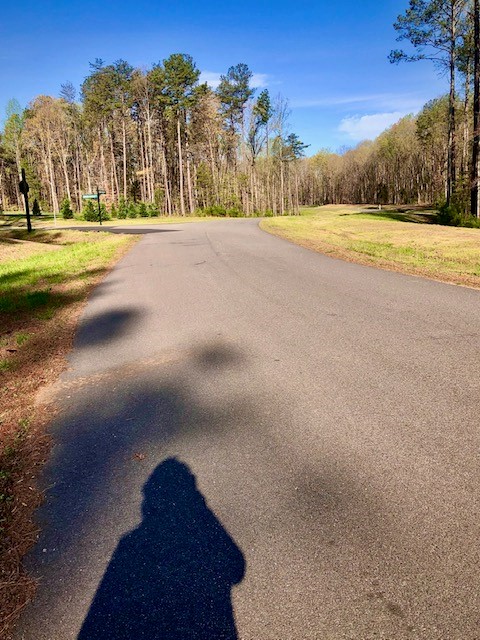
This morning as I walked, I took two pictures. One captures the road behind me, holding the camera over my shoulder to show where I’ve been.

The second picture is a look ahead. Given the time of the morning, it’s interesting to ponder how my shadow is going before me. That will have to be a post for another day.

My thoughts turned to how very different this Holy Week will be from the ones of the past. The first true Palm Sunday parade I was part of was toward the end of my high school years. Revs. Bob and Bea Callis were at Fieldale UMC. They led a parade of the congregation from the ballpark to the church, donkey and all. My feet were washed for the first time on Maundy Thursday during a Wesley Foundation gathering at Edenton Street UMC in Raleigh. After so many moving Tenebrae Good Friday services, the day must begin with the singing of “The Light of Christ surrounds us….” and include the Taize chorus of “Stay with me, Remain here with me, Watch and pray, Watch and pray.” And Easter Sunday has to begin in the dark and include a litany of the many ways you can title a sermon using “The Tomb is Empty.”

This year: evergreen branches by the front door, a Palm Sunday parade that started with deer and ended with blue birds, online worship, deep prayer, sadness and joy. I wonder if we’re learning what is really important about following Christ during this strange time. I wonder if the lessons of turning over the tables in the temple, entering into deep discernment alone about the future while wanting others to be present, reminiscing with friends that have been traveling this road with us, facing sadness and possible death, and waiting…will change us. Are we supposed to be learning how to truly be authentic followers of Jesus during this time of physical distancing? Will the “new normal” for each of us and for the church be transformed as we learn from our current experience?

Just when I thought I might be coming out of my fog of grief, even in anticipation of the first Easter without going to church with Mom, there are new types of grief taking hold. On Friday, Steve found out that a dear friend and mentor was hospitalized following a stroke. We didn’t know how severe the stroke had been until yesterday when word came that this amazing man may only be here with us a few more days. The conversations of which I’ve been a part over the past few weeks of allowing family in for compassionate care/end-of-life visits and the stories of medical personnel who have been with persons otherwise alone when death has come began to flood my mind. As we sat together last night grieving both a life that is dear to us and the fact that the goodbyes have to be said in awkward and unnatural ways led both of us to tears. We have so many memories of the amazing life lived by our friend. He was one of the first to reach out when my Mom died in October. His son shared with us last night that he continued to visit the assisted living community where his wife lived for a brief time before her death last summer to bring joy to other residents. His last visit to our house was right around Valentine’s Day. Always the perfect gentleman, he walked in with a box of Russell Stover chocolate candy. The dogs cuddled up next to him as he and Steve shared the stories once again of how their working relationship began. A call to him was the first I had to make when the surgeon reported on Steve’s surgery on February 20th. The next morning, our friend was at the hospital before I got there, watching as the physical therapists got Steve up for the first time. He called to make sure I safely got Steve in the house later that afternoon and called several times over the following weekend to say he’d be here as soon as possible if I needed him for anything.

The road behind has had its share of grief, loss, love, joy and adventure. It has been filled with God’s blessings.

The road ahead??

It will be different, different than what I expected just a few weeks ago and probably very different from what I think it will be even today. Will this time of quiet call us as individuals and as a church to recognize what is truly important: relationships, communication, less attention to “busyness”? Will committee meetings that often leave us wondering why we were present give way to true connection and transformation? Will the prayers of the people continue to be focused more on the needs of the community and world around us than on our individual petitions? Will the sense of urgency that has caused us to shelter in place bring about a sense of unity that moves us to more deeply care for one another and all of God’s creation?

I’ll be eagerly looking for the continuing lessons of this odd and uncomfortable Holy Week, many of which I anticipate will actually make it more similar to the road that Jesus walked than any Holy Week I have experienced before. As the shadow walks ahead of me, may I focus more clearly on the purpose of the journey.

What a Difference a Year Can Make

Over the weekend as I was Googling thoughts about the end of the year, I found the quote below. It seemed so very appropriate for my journey through 2019 and the start of the new year. You might feel the same way about where you find yourself tonight.

My last post was on October 12th as I sat in the chair beside my mother’s bed. We knew her death was imminent and came three days later. In many ways, it’s been a long 11 weeks. Some days it seems like minutes ago that the call of the charge nurse changed our lives. This time of grief and mourning has taken some interesting turns. Each one a sacred space of its own. Each one a step that has been necessary to put pieces back together.

Looking back on 2019, my soul began to change a little each time another letter or email came from an individual or church related to the Called General Conference of The United Methodist Church. I read of congregations that had changed the lives of individuals and families through their love and acceptance of differences of all types. I cried with each remembrance of how those writing felt they could not have survived in life or in the church without the deep care and compassion of those they called their family of faith. I cried harder – screamed at times, hit the table at times, wanted to run and hide at times (and did) – when the messages contained much anger and harmful language, not just toward persons of the LGBTQIA+ community but everyone who was not just like the person writing. By the time of the General Conference at the end of February, I felt that there were enough people in the church that disapproved of me for one reason or another that I was lost. Letters shared dislike of women in leadership, God’s disapproval of all who could not or have not reproduced naturally, those who do not read and accept scripture very literally, and on and on. I fall into so many of those “categories” that I felt unwelcomed.

I couldn’t force myself through the doors of a church until Easter. Only then it was because Easter and Christmas Eve had become milestones for Mom. When illness hit, the goal was to make it to that next big church service. With her bout with pneumonia in the summer of 2018, Christmas Eve last year was a huge accomplishment, and then we made it to Easter 2019. No matter how many pieces my soul and faith had been broken into, we had to be present. As they had done since Christmas of 2015, it was the people of Culpeper UMC who welcomed us as visitors and broken spirits once again. Their warmth was the Light that was needed for our family. That service did end up being the last time that Mom, Steve and I were in worship together.

The community of faith that has emerged for me during 2019 has taken many forms. The uniqueness of each piece has formed me into a person that is very different than the one that started 2019.

  • The group that attended the UMCNext event in Kansas in May. Oh the stories that were shared around tables and in times of fellowship. The hurt, the harm, the joy, the faith…oh the amazing faith of so many who have been broken and pieced back together by the love of Jesus.
  • The work of so many to seek justice, to forge relationships, to start new conversations, to raise new voices so that the church can be a church where all are welcomed, nurtured and loved no matter what.
  • The work colleagues who only a few hours after hearing me speak about recognizing the needs of the growing number of “elder orphans” walked with me through the journey of becoming one.
  • The individuals who sat with me as I cried for my mother, for the church I love, for the world. From those in St. Louis who listened to the hurt in my heart to the dear friends who called and texted from afar to share their memories of Mom and offer their support…from the retired clergy partner who carried water in cupped hands across the parking lot so that I would not be excluded from remembering my baptism to the college friend who sent a handmade jeweled angel in a Christmas card…from the poor church folk (and most importantly Steve) who have had to listen to my voice crack as I attempt to sing once again to the cousin in Florida who thanked me for letting our mother be his mother, too.

I am a very different person on December 31, 2019, than I was on January 1st. The pieces are beginning to come back together with the help and support of a village.

Another quote popped into my Google search that I’m using to close out this year and look into 2020. For a couple of years, some intentionally and some purely through God’s grace, I’ve grabbed hold of the practice of choosing a word or phrase to guide me through the year. In 2016, it was a phrase from the Book of Esther: “for such a time as this.” On the first Sunday of 2017, Steve and I were guests in a church service where a cutout star was given to each person with a word for the year. My word was “possibility,” a very appropriate word in a year of building a new home and moving to a new community. Last year, the word/phrase came from a delegation meeting: “GentleHopefulThisness.” For 2019, it’s going to be “Delicious Ambiguity.” Thank you, Gilda Radner, for the inspiration.

“I wanted a perfect ending. Now I’ve learned, the hard way, that some poems don’t rhyme, and some stories don’t have a clear beginning, middle, and end. Life is about not knowing, having to change, taking the moment and making the best of it, without knowing what’s going to happen next. Delicious Ambiguity.”

Here’s to 2020 and pieces that will fit together in now unknown yet delicious ways.

Inseparable: The Journey of Losing a Parent and Losing a Church

For a little over four years, I’ve been on an intimately intertwined journey of walking with my mother toward the end of life and hiking the hills and valleys of the future of The United Methodist Church.

These paths have been tightly woven. Mom entered the hospital two days before our first meeting of the Virginia Conference delegation to the 2016 General Conference. I left Roanoke Memorial Hospital after spending the night by her side to do my best to lead the delegation meeting. Two days later she would enter long-term care in Culpeper. The first bout of pneumonia followed in a few weeks.

I prayed constantly leading up to the General Conference in Portland in May 2016 that she would be healthy while I was away. She was, but things took a turn for the Southeastern Jurisdictional Conference that July. 

More bouts with pneumonia, congestive heart failure, times of oxygen deprived cognitive impairment from the heart and pulmonary fibrosis. Mom’s little body has been through a lot. We thought she was near death in August of last year after the second bout with pneumonia in 6-weeks. Yet she fought. By the start of this year and the Called General Conference session, I was back to praying constantly that she would be healthy during my time in St. Louis. She was.

This past Sunday, her health took a turn once again. Today as I sat by her bedside, she stirred very little after a difficult night. Her breathing is labored. Her skin extremely thin. Her heart that has beaten strong for almost 94 years is growing weaker. She can’t understand why all this is happening to her.

This is the heart that modeled for me that all people – without exception – are loved by God. This is the soul that encouraged me to use my gifts for work in the church. Now of course Mom was the one who always said her only gift was washing dishes and that’s why you could always find her in the church kitchen. What that taught me was that everybody has some gift to use toward bringing about God’s kingdom: every gift is important.  It was her hands and feet that taught me how to visit the sick, feed the hungry and care for the broken-hearted. She embodied the Gospel message that I heard in church.

As my mother has been fighting to live for the last four years, my beloved church has been fighting over how to live out just what I stated above: that we are all loved by God, that we all have gifts for ministry and that we are the hands and feet of Christ in the ever changing world of today. Not only have I been losing the physical presence of my mother, I’ve been losing what is most deeply ingrained in my faith about what the church is supposed to be.

I can’t separate the two journeys. I am who I am because of my mother. I am also the person I am today because of The UMC.  

This struggle brings me to tears, leaves me confused, makes me angry, causes me great pain – as a daughter and as a United Methodist Christian. One path on the journey will likely come to an end soon. What will happen with the other?

“After all our hopes and dreams
have come and gone,
and our children sift thru all
we’ve left behind,
may the clues that they discover,
and the mem’ries they uncover,
become the light that leads them,
to the road we each must find.

O may all who come behind us
find us faithful,
may the fire of our devotion
light their way.
May the footprints that we leave,
lead them to believe,
and the lives we live
inspire them to obey.
O may all who come behind us
find us faithful.”

Find Us Faithful by Steve Green


priv·i·lege

“Google, define privilege.”

From vocabulary.com comes this response: “A privilege is a special advantage not enjoyed by everyone…. Privilege comes from Latin privilegium, meaning a law for just one person, and means a benefit enjoyed by an individual or group beyond what’s available to others.”

I hear and experience this word over and over in leadership in The United Methodist Church these days. Yesterday, my heart moved into my throat a number of times during a meeting as I sat once again in conversations around lack of diversity in general in the Virginia Conference and the spectrum of theological understandings in our denomination. My own pain – and empathy for others – in these anxious times choked me.

The UMC General Commission on Religion and Race offers a personal and/or group activity where you are asked to list your ideas for “What’s next” in your personal or group journey in addressing racism in particular and privilege in general. For each idea, you’re asked to plan three action steps: (1) what you need to LEARN in order to do faithful and effective work, (2) ways you or your church can SHARE what you’ve learned, and (3) what you are willing to RISK in order to accomplish the learning and sharing.

I haven’t slept well these past two nights. I know the Spirit is stirring but I’m not quite sure yet where that’s headed. Tonight, however, the direction seems to be in reflection of my own story of privilege as a blue-eyed/fair-skinned, CIS gendered, educated, employed, home owning, (too) well fed, middle aged, American, United Methodist female. That list could go on.

I had nothing to do with the blue-eyed, fair-skinned female privilege. This DNA-controlled part of my journey started in Appalachia – certainly not a place of privilege: in the sweat of a sharecropper working a field of tobacco, the farmer’s wife with 9 children born in the early 1900s, the West Virginia coal miners and the factory workers of Georgia, North Carolina and Virginia. It wasn’t until I was a preteen that I realized my factory working parents went each year to the local loan office to borrow enough money for a one-week trip to the beach. They worked the rest of the year to pay off the loan. Today, we’d be the family at the paycheck lending window. Today, I am the daughter of a woman who worked all her life, saved all she could, did as much for me as she could, and at 93 has to rely on Medicaid for her daily care. Today, I carry the mark of my Irish heritage in the white spot in the middle of my neck under my chin. I can’t get away from my blue-eyed, fair-skinned privilege, but I certainly recognize my family history that comes with it.

The educated part of my privilege could have easily not happened. I still hold anger toward the Reagan Administration for cutting out my Veteran’s Administration survivor benefits during the summer months. When I started college, I was receiving support for my education from my father’s service in World War II. During President Reagan’s tenure, the decision was made to provide those payments for only the nine months of the typical school year. If it wasn’t for the bank loans, work study jobs, and other financial assistance, I wouldn’t be “educated.” And it only took me 10 additional years to pay it all off. My poor mother felt so sorry for me after moving me into college because I didn’t have the same “things” as the other girls that on her first visit to campus that fall, she brought me a gift of a gold add-a-bead necklace and a pink Izod pullover shirt. She wanted me to “fit in” with those of greater privilege.

I could go on with parts of my journey of privilege: living on the white side of street in the little town where I grew up and daily walking past the black community pool and ballfields, giving up the Girl Scout Christmas party gift so that the girl whose family couldn’t afford to bring one went home with one of the best, striving for a church that is the living embodiment of the Kin-dom of God….

I recognize that I am privileged in so many ways. That realization grows stronger with each step in my journey of faith. What am I to do with the learnings? How am I to share what I have experienced? What am I now called to risk when some days, I feel like I’ve risked it all already?

In these early morning hours, I’m reminded of these words from We Make the Road by Walking by Brian D. McLaren :

We have to graduate from thinking in terms of “our kind versus their kind” to think in terms of “humankind”….We must find a new approach, make a new road, pioneer a new way of living as neighbors in one human community as brothers and sisters in one family of creation. (p. 217)

And so, I keep walking home….

The Challenge is Not a Delegation: The Challenge is Lay Leadership Development

When I was 15 – as I was just getting ready to start my sophomore year in high school, a new clergy appointment was made to my home church in Fieldale. Rev. Robert (“Bob”) James Callis, Jr., came with his spouse be our preacher.

As her memoir from the 2003 Annual Conference Remembrance Service read, Bea Callis was “a woman before her time.” She answered the call in 1954, and joined Rev. Bob in ministry. Mrs. Bea, as she preferred to be called, was never ordained an elder in the Virginia Annual Conference, but was licensed as a local pastor in 1954, ordained a deacon in 1961, and ordained a local elder in 1963. Also noted in her memoir is the fact that she “would always carry a white handkerchief in one hand and a yellow legal pad in the other, writing down new ideas as God spoke to her.”  To this day, I carry one of her handkerchiefs with me whenever I am invited to sing for a funeral.

Maybe Rev. Bob and Mrs. Bea carefully observed gifts and graces that I was beginning to display in my teenage years. Maybe they just knew that my mom and I were still in transition from the death of my dad a little more than a year before their arrival in Fieldale and needed some extra nurturing. For whatever reason, Rev. Bob and Mrs. Bea took me under wing and offered me every imaginable opportunity to explore my gifts in service to the church.

  • Not long into their ministry in Fieldale, Mrs. Bea asked me if I’d be willing to create weekly bulletin boards outside the church office door to go along with the Sunday message. At one point she even handed me scraps of fabric and lace from her wedding dress to use in designing something for a special service of renewal of wedding vows for any of the couples in the church that wanted to participate.  This was my entry into creating visuals to enhance worship experiences.
  • Rev. Bob soon asked me if I would consider being the youth representative on what was then the Martinsville and Henry County Cluster of churches on the Danville District. I attended those meetings as the only young person and usually the only female in the group.  Being old enough to drive by then, I would go alone to the meetings, sit there and try to share my opinions with the group of older white men. These days I hope First Church in Martinsville and the Danville District have child protection policies in place that would never allow that to happen. This was my entry into leadership beyond the local churh.
  • Mrs. Bea was a tremendous preacher and was often asked to preach for services across the area. One Advent she spoke at Ridgeway UMC and extended an invitation for me to come along to sing a solo. I had never heard the hymn she asked me to sing. I practiced and practiced and practiced until I thought I finally had it down. That night in front of the congregation in Ridgeway I was just like Sarah Grace standing before the Annual Conference on Saturday morning. Whatever I sang was awful; I wouldn’t even say it was a unique version. I was devastated that I had let Mrs. Bea down. I just wanted to run and hide. Yet, Mrs. Bea hugged me, telling me what a wonderful job I had done. I will tell you that to this day I cannot sing “Lo, How a Rose E’er Blooming” without thinking back to that most embarrassing moment.

With all that they did to encourage me in my call, the greatest gift that Rev. Bob and Mrs. Bea gave me was experiencing so closely their passion for making disciples. The services they planned were different, not the same sitting in the pew listening to 3-point preaching that I had grown up experiencing.  The church filled with people.  My little church was making a difference: advocating for change, serving the community, making life long learners.  It wouldn’t be long, however, before the older white men that had control of the church – financially and otherwise – would say that they didn’t want a female offering as much leadership as Mrs. Bea was providing. From my memory, they especially didn’t like her preaching from the pulpit. After only three years, and days after Rev. Bob brought the message for my high school baccalaureate service, they were appointed to a new church.

The gift they left with me was one of forgiveness and reconciliation.  They loved the community and people so much that they declared they would return to the area when they retired. And they did in 1991. Not long before he died in 2011, Rev. Bob gave me Mrs. Bea’s licenses and ordination certificates to take to the Conference Achieves. To their last breaths, they continued to see potential in me that I couldn’t see clearly in myself.  Mrs. Bea was one of the reasons I considered entering ordained ministry, only to be told just a few short years later by the male minister that followed them in Fieldale that he would not support my decision since ministry in The UMC was not a place for young women.

We have a challenge within our Virginia United Methodist churches with helping laity discover and explore their calls to ministry. Actually, the challenge is everywhere in the church.  On Saturday at this year’s Annual Conference, we were urged by representatives from the Commission on Ethnic Minority Concerns and Advocacy (CEMCA) and the Commission on the Role and Status of Women (COSROW) to enter into holy conversation about the lack of racial and ethnic diversity on the newly elected General and Jurisdictional Conference delegations. The challenge is much larger than the makeup of the delegation.  It is an overall lay leadership challenge. On a district and conference level, we’ve never been able to fill all the positions needed to truly represent an inclusive church on levels outside the local church. And our local churches continue to be the most segregated places around.  If we don’t begin to focus a true priority on developing our lay leaders, there will be no formal expression of church to worry about at all.

  • Of the 80+ lay nominations (including those from the floor of Annual Conference), approximately 1% were people of color and diverse ethnic backgrounds.  One percent. At least one of those persons when asked about why they wanted to serve on the delegation had no idea what the major challenges before the denomination even were. Regardless of their cultural and ethnic background, is that the type of person we want to send to General or Jurisdictional Conference?  Unless we educate leaders on the current realities of the denomination, there will be no formal expression of church to worry about at all.
  • There was a lay member of one of our larger churches in the Annual Conference who stood before me at the Laity Meet and Greet for nominees on Thursday that said he did not have specific questions for me, but needed assistance.  The person went on: “This is my first time at Annual Conference, and I have no idea what I am to do. Can you help me understand what I’m supposed do?”  This was a lay member representing one of our larger congregations.  We need to help those we name to any role understand the expectations and responsibilities of the role they are filling.  Unless we better prepare leaders, there will be no formal expression of church to worry about at all.
  • Another person shared that they had been in a training I offered for their district for new local church Lay Leaders.  By the best of my recollection, given the district, that training must have been at least 12 years ago. As we continued to talk, the individual added, “And I’m still the Lay Leader.”  As lay leaders in all roles, our main task is to multiple leaders, share our experience and mentor others.  Unless we are intentional in leadership development, there will be no formal expression of church to worry about at all.

There is a huge leadership problem when individuals who put their names up for nomination to the most important gathering in the life of our church say they have no idea what is going on. There is a huge leadership problem when our Lay Members to Annual Conference look you straight in the eye and say they don’t know what they are supposed to do. Until we make lay leadership development a true priority for the roughly 360,000 of us lay people in the Virginia Conference, things are not going to change.  The issue is not about the makeup the delegation. The question is about how we encourage our laity to use their gifts in leadership positions inside and outside the local church. Only when we do that will our delegations to General and Jurisdictional Conference look different.

However, we do have to recognize that this delegation is very different in other ways from any past Virginia delegations.

  • It’s younger. Take away us oldest folks and my guess is that the average age would be somewhere close to 40.
  • Nine of the 22 General Conference delegates have not served before.  New, passionate voices for a new reality in the life of the denomination!
  • I’ve heard people say the delegation doesn’t represent the small church. It does, just in a very different way. Most of us even from the Richmond, Northern Virginia and Tidewater areas grew up and have our roots in small churches across the  Conference.  A number of folks on the delegation are active in those small churches. A few of the young leaders are in new church plants. They are small churches, yet they are different. They are small churches that are new expressions of what it looks like to be church in their communities.

Even though I tried for so many years to make a difference in lay leadership in the Virginia Conference, my efforts weren’t as fruitful as I had dreamed. We’re still pretty much in the same situation we’ve always been. For that reality, I will always carry a heaviness in my soul. Yet my heart feels so much more joy after gathering with Virginia United Methodist last week.  Between the UMCNext gathering in May and events of Annual Conference, I saw a glimpse of what the Beloved Community looks like: diverse in age, experiences, lifestyles, cultural backgrounds, ethnicities, ability levels and more.

I still don’t know what form the United Methodist Church in the United States might take, but I’m excited by the leadership potential that I see in this new delegation for moving this journey forward. More than likely I won’t be here on this earth to see what fully develops. Yet I know that I have tremendous faith in those younger than I am on this delegation to make sure that our Wesleyan heritage continues in ways that will impact generations to come after me.

I hope Rev. Bob and Mrs. Bea are proud of what they started.  May I follow their example in helping raise up the next group of leaders for the Virginia Conference – but I’m not going to ask any of them to sing “Lo, How a Rose E’er Blooming.”

Anticipating the 2019 Annual Conference

Here we are two days before the start of the Virginia United Methodist Annual Conference. Each day seems to bring another couple of emails from lay members to this year’s Annual Conference asking basically the same question, using the same language:  “I am my church’s representative to Virginia Annual Conference and will be voting for General Conference representatives.  I realize that the particular options addressed at the 2019 Special General Conference are no longer the specific issues that will be on the agenda for 2020, however, if you were to vote on the 3 options that were presented at 2019 conference, please identify which one you would choose and why:  The One Church Plan, the Connectional Conference Plan, or the Traditionalist Plan.”  

I’ve given basically the same response to everyone.  Some have offered kind responses; others have not responded at all.  With each, I have directed them to this blog if they truly want to know more about me.

Over the weekend, I was looking back at some old computer files and came across some of my reflection papers from the courses I took to receive professional certification in the denomination in Older Adult Ministries.  I also stumbled upon the electronic copy of my application statement to the Board of Ordained Ministry for that certification. It’s amazing how the dates could be changed and these writings shared today to reflect where I find myself in this journey with The UMC. 

So, I decided to share that autobiographical statement – without changes from 2007.  If you’re visiting this blog to learn more about me as a potential delegate to the 2020 General Conference, you will see exactly who I am in these words: reflections not coming from the Called General Conference session, but who I have always been and will continue to be. 

July 27, 2007: In the space below, write an autobiographical statement regarding your Christian experience, call to ministry, formative Christian experiences, and plans for service in the Church. Please keep this response to one page.

I have been a lifelong Virginia Methodist, baptized Methodist and confirmed United Methodist.  However, my theology, my understanding of God, has never been stretched and challenged as it has been in the seven years that I have served on the conference staff.  I am blessed to be in ministry with amazing people from all walks of life, ability levels, and backgrounds. In my local church – Shady Grove (Glen Allen) on the Richmond District, I am currently chair of the music and arts committee, chair of the worship task force, worship and song leader, and certified lay speaker. All the situations in which I have found myself and the current realities of The United Methodist Church here and around the world have had a tremendous impact on my understanding of the role of the church in my daily life and of my understanding of God, Jesus Christ, and the power of the Holy Spirit. My theology has become truly dynamic; ever changing and making me reach beyond myself.

When I reflect on my conference work and local church activities, my thinking always returns to the role of lay leadership in the church, no matter what level that is on: conference, jurisdiction, or local church.  Much of that comes from my embedded theology. I have always understood the need for laity to assume leadership and give vision for the church.  My earliest recollections of church are memories of my parents and family members taking an active role in Fieldale UMC (Danville District), from singing in the choir and providing worship leadership to serving as congregational care visitors and church council members.  I became involved in church leadership as a teenager.  I firmly believe that the example Christ modeled and that the early church offered to us is one of the church rising up from the people.  As lay spiritual leaders, each one of us is called to discover our spiritual gifts, the passion that God placed in our hearts, and our personal style which will help us follow through on God’s directions for service. I truly believe that one of my gifts is building relationships in and through the church with persons with special needs due to disability, illness, aging, and other challenges.        

My Christian journey has been one of continuing struggle to identify what God is calling me to do and my role in the church. It is a question I’ve been trying to answer for more than 25 years when I first felt a call to ordained ministry.  I think I have finally realized that there is a unique lay leadership role I am called to fill.  I have found that as I’ve talked about my “call” over the last few years, my tone has changed. I have become more determined to live out this call as a strong lay voice and encourage others to do the same.  Professional certification in Older Adult Ministry will allow me to combine this call to lay ministry with my desire to work toward an inclusive church where all people, no matter what their ages or abilities, are seen as valued members of the Body of Christ.

The Holy Spirit continues to move in my life in new and miraculous ways each and every day.  Whether God’s call is for me to continue my work with older adults and those with unique needs on the Conference level or at some point to serve older adults in the local church, my prayer is that God will bless me with the patience to continue waiting as I’m shaped and as these ministries are formed by the Spirit

If I Click My Heels Three Times…

As the wind whipped around the Fairfield Inn and Suites Monday night in Overland Park, KS, I wished for a pair of red sequined pumps. Tornado warnings across the Midwest, not right where we were, but close enough ran across the weather reports. Torrential rain poured down. I awoke at 2:15 AM to the sound of the wind and checked to see if a watch had been issued. I wished for red shoes and the ability to click my heels three times to get home.

Earlier in the evening I had been part of a gathering discussing the future of The UMC that left me uneasy and restless. I was uncomfortable with the strength of the language being used. The theology was not easy for me to hear. The hurt was palpable, the anger heavy. While I needed to listen and experience it all, I wanted to click my heels together to get out of the space – immediately. Many of those in the room had been feeling that way about The UMC for decades but were continuing to challenge us to see a wider vision for the church. My feet – without red shoes to take me away – needed to be in that sacred place.

Then by the end of the day yesterday, I could see a glimmer of the church I have always dreamed of being part of, a church that could actually reflect what I think the kingdom of God is supposed to be. I began to feel that even without ruby red slippers, I could be at home with God in a place that models the teachings of Jesus as I understand them and the means of grace in our Wesleyan roots that I love so deeply.

That home was a table filled with authentic stories of hurt and harm, surprise and resurrection: his and her pronouns, LGBTQIA+ and cisgendered, urban and rural, clergy and lay, Black and White, resisting, leaving and staying in The UMC.

That home was a place of worship and conversation where everyone was safe to be who God intended us to be, knowing that despite how we look, who we love, what our histories say about us, and how we speak, God loves us all unconditionally.

That home was a place where we felt the weight of the “structure” sitting on our chests, knowing we had to find a way to emerge from underneath but having no idea how. There was a clear recognition that every individual and church may have to find a different way out from under the weathered, battered house. Some may feel compelled to stay and struggle to rebuild. Others will need to step away with what is left of the walls and possessions, landing in a new community of connection. Still others may need to dissolve the connection to the original foundation all together. No one has any idea at this point where the road will lead. There certainly are no yellow bricks guiding us on the path ahead. There is no good witch to lead us to the great of Oz.

There is great wisdom. There is amazing courage. There is more heart, more love, than you can imagine. There are strong winds of change blowing.

But don’t be naive. There are armies of challenges flying all around us. There will be days of unknowing, long periods of wandering in scary dark forests and the disillusionment of finding that Oz may not be all great and powerful.

With or without the ruby slippers and with much harder work ahead than just clicking my heels three times, I can affirm my commitment to the tenets of UMCNext.

  • To be passionate followers of Jesus Christ, committed to a Wesleyan vision of Christianity.
  • To resist evil, injustice and oppression in all forms and toward all people and build a church which affirms the full participation of all ages, nations, races, classes, cultures, gender identities, sexual orientations and abilities.
  • To reject the Traditional Plan approved at General Conference 2019 as inconsistent with the gospel of Jesus Christ and resist its implementation.
  • To work to eliminate discriminatory language and the restrictions and penalties in the Book of Discipline regarding LGBTQ individuals.

This is where I was called by my baptism to be. This is where I hear my membership vows directing my steps. Right now, I still don’t know if all that is leading to a particular place of brick and mortar. I do know it’s leading me home.

Just When I Think I’m Doing Better

People continue to ask me if I’ve “recovered” from the Called UMC General Conference.  I know they are asking that question with the best intent.  My response is consistent: just when I think I’m doing better, something happens that puts me right back to February 26th.  I liken it to a post traumatic stress response.  Yet I feel badly using that description because my response is nothing like what those living with true PTSD experience.

Email and Facebook messages are coming once again in anticipation of Annual Conference.  And I am headed right back down the same path that I thought I was stepping off.

Yesterday, one message ended with these words: “I trust you to be a better person than to believe that your way is the way of love and the way of others is not.”

My day started today with these questions about why I was not accepting of “God’s will” as it was prayed for at the Called Session:  “Don’t you believe in prayer?  When did you stop?  When you didn’t get your way?” 

And one last statement: “Furthermore, do you really believe, ‘We should all be able to love and serve Jesus together no matter what our understandings’?”  (My words from a recent Facebook post are the ones in single quotes.)

Since the day in April of 1961 when I was baptized at the font of Fieldale Methodist Church, I’ve experienced my share of unChristian-like behavior in church, when we’ve quarreled over ministries (and ministers); when feelings have been hurt and hearts damaged; when we have forgotten that we – the people – are the church, not a building; and when we have failed to live as the people we claim to be – the people Jesus tried so hard to teach us to be.  Despite all this, one of the main reasons I continue to be United Methodist is our understanding of grace. A loving God cares for me no matter how undeserving I may be.  And that grace has been with me from my first moment.  No person can give it to me or take it away: only God…and God did all that work through Jesus on my behalf well before I came into this world.  My job – that comes with the vow I repeat each time someone is baptized or joins the church — is to live like I believe it.  That’s the true meaning of our baptism: God’s grace is with us throughout our entire journey of faith, through good and bad, and in return, we are to share that same unconditional love with others through our words and actions.

I love the congregational response that is in the Baptismal Covenant II service in our hymnal.

With God’s help we will proclaim the good news and live according to the example of Christ.  We will surround these persons with a community of love and forgiveness, that they may grow in their service to others.  We will pray for them, that they may be true disciples who walk in the way that leads to life.

There must have been something strange in that water from the Smith River in Fieldale.  I still believe that the words spoken by the congregation as that water was placed on my head 58 years ago mean something.  I’m still searching for that community of love and forgiveness, but I know there was something in that water that I’m called to live by, to advocate for, to move on toward perfection to reach.  There must have been….

Holy Week Trees, Part 1

It was the spring of 1975. There needed to be new life in the trees. After all, there had to be a new way of life in our house. My Dad had died at the end of February; February 28th to be exact. Life was different. I was mad at him and my Mom before he died because they hadn’t let me get a new outfit that I just had to have from what was then Leggett’s. For those too young to know that name, it’s now Belk. I had wanted that mint green pantsuit so badly to wear on a trip to see Godspell with the school choir. The money was not there. I cried and of course, like any barely 14 year old girl, fumed in anger that they would’t let me have it. Then the trip was cancelled so I wouldn’t have had the special reason to wear it.

A few days later I cried, not another silly teenage outburst but because my Dad suddenly died. The last days of winter that year would be like none before. On that particular February day, all I wanted to do was to do something. My mother’s sisters and our neighbors flooded into our house to prepare it for the arrival of family and friends. I still remember just wanting to be the one to clean my room, to make up my bed, to put my own stuff away. No one would let me. No one would let me do anything around the house. I finally went out on the front porch, leaned up against a post and watched the school buses as they began taking other students home for the afternoon. It seemed too “normal” so I finally went down to the back of the house and just walked. I walked up and down the creek bed behind our house and the four others around us. I walked and walked, back and forth, until I had cried enough.

No one seemed to notice that I came back. In all the busyness, honestly no one probably had noticed I was gone. Then people began to visit, telling stories that I had never heard about my father: stories of his time in World War II, stories of the factory in Ridgeway, stories of the music he sang and the instruments he played. I got that mint green pantsuit: not to wear to a long awaited outing with teenage friends, but to my Dad’s funeral.

Weeks later as Mom and I made numerous trips to the cemetery and tried to start a new “normal,” the flowers began to bloom, the trees began to bud with the new life of spring. There was a good size hardwood tree, I believe a maple, that stood between the two rows of graves where my father and several of our other family members were buried or had plots. Remember, this was 1975 and folks back then bought those cemetery plots often well ahead of any need. My parents had done that; in fact, they originally bought four plots that included one for my brother and one for me. Thank goodness my mother sold those two many years ago.

Like I had begged for that polyester pantsuit, I remember asking Mom over and over if I could hang something in the limbs of that tree as they spread over Daddy’s marker. First it was a hanging basket of flowers, then a birdhouse. The birdhouse remained there for years. I needed to see hope, life, fruitfulness when I visited that sacred space.

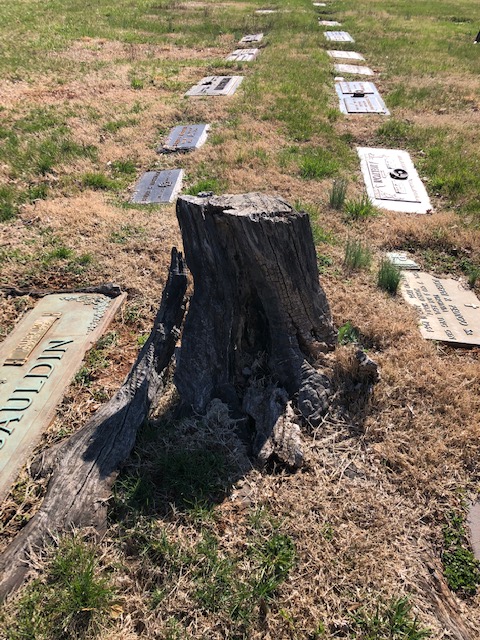
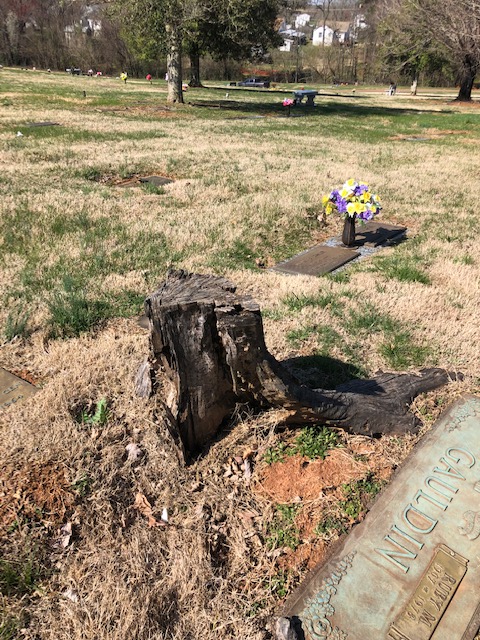
A couple of weeks ago, I stopped to put spring flowers on my Dad’s grave. The tree has been gone for many years now, but the stump remains. This spring, as the flowers were beginning to bloom and the trees beginning to bud, the stump brought more tears than ever. On the heels of the Called General Conference session, it reminded me once again of my broken heart and feelings of loss.

I sometimes find myself telling people that my responses to many situations in these day following the February 26th end of the General Conference session feels a little like Post-Traumatic Stress Disorder (PTSD). I’m coming to believe more and more deeply as I try to deal with this time in my faith journey that there are deep connections between living through my father’s death, walking through Mom’s health experiences and aging during these last four years and losing my church as I want it to be. It’s not exactly the same type of PTSD that so many seriously have to find ways to live with and through, and I often feel badly even attempting to compare it to such deep, deep traumatic experiences. Yet, it is a trauma-related stress reaction that for weeks now has manifested itself as little things like having difficulty speaking the words to describe the experience to more emotional responses of crying and withdrawal.

I made a list earlier this week of all the Maundy Thursday services near us, including our own at Shady Grove UMC. I thought I was ready to enter this Holy Week in the community of faith. I have to confess now that I haven’t gotten myself back to worship yet. For my clergy friends, I know you had to face your congregations immediately after General Conference and I have great admiration for how you were all able to handle that. I could not, and have not been able to do so. But, I thought I was ready this week. After all, what better week could there be to take the next step in mourning to move toward resurrection. I couldn’t, but we sat around the dinner table with Ashley and Lily sharing a meal, looking at the young life in front of me loving the warm, soft bread shared with her. And now, shedding a few tears in the middle of the night.

Wonder if Jesus did the same thing after leaving that last supper? Tonight I have to believe he did, wondering what the tree he was planting would look like in the years to come.