A member of Generation Jones – the latter half of the Boomers and first year of Gen Xers yearning to make a difference. Commenting on my own life story to impact those of us trying to be the best lay leaders we can be while we attempt to figure this United Methodist thing out.
I remember the day as if it were yesterday. The sand on the southern North Carolina beach was still warm, despite it being October. The sun was just rising above the horizon, filling the clear sky with shades of pinks and yellows. Salty air ascended from the waves which gently lapped the shore. Seems like yesterday – but it was 45 years ago.
I was an 18-year old college freshman. I had never been on a retreat of any kind, much less a spiritual one. But there I was on this beach for a weekend with a group of college students I had only known a very short time: sharing living space, telling our stories, trying to figure out how to navigate this new threshold of college and young adulthood.
The Raleigh Wesley Foundation had an intern/student pastor that fall from Duke Divinity School. She led the service of Holy Communion on the beach that Sunday morning. As I stood before her to receive the bread and cup, she called me by name.
I’d never been called by name before as I came forward for communion. It was as if in that moment God was speaking my name.
I felt a closeness to God that morning that I hadn’t experienced before. There in the breeze coming off the ocean, I had been called by name.
It felt like my Samuel moment. You might know the story of Samuel’s call when Samuel thought his mentor Eli was calling him multiple times in the night, but all along it was God. When Eli realized it was the Lord calling, he told Samuel to respond the next time by saying, “Speak, Lord. Your servant is listening.” (1 Samuel 3:1-11)
I felt as if I finally understood the words from the Prophet Isaiah: “But now, says the Lord…I have called you by name; you are mine.” (Isaiah 43:1)
On that beach, sun warming the air, waves singing their eternal song – I had been called by name. It seems like only yesterday.
Ever since that day, the question has been, “Now, God, what are you calling me to? – to do, to be, to understand, to and with whom?”
At one point a few short years after that morning on the beach, I was certain the call was to serve the church.
When I entered graduate school, I was sure I was going to rid the world of injustice and hurt as a professional social worker.
Forty-five years later, this fall I’m moving through the threshold of retirement on a journey of finding my place of resurrection – that place where God is calling me to right now, the place where my spirit is most alive in this new season. These days it’s not the rays of the morning sun reflecting on the ocean, but streaming through the trees of our yard. It’s not the smell of salt water and the feel of warm sand, but the hint of smoldering wood from a nearby firepit and the crush of falling leaves. God continues to call my name — and I move through each day asking God to show me where I am being called to respond; what I’m being called to do, to be, to understand; how I am being called to act and to find peace – in the midst of a very anxious time.
I’ll confess that the first four months of retirement have been hard. “Hard” may not be a strong enough descriptor. Sleep has been one of the major challenges. When one spouse has been living in retirement for 10 years and the other finally joins this new season of life, habits, interests, and wellness become more differentiated. That is especially true when one’s retirement passion keeps him up very late at least three nights a week. That’s been the case for years, but I’ve been able to sleep my way through, knowing that I had to get up for work. Now, I find myself wide awake when Steve comes to bed. Oh, how the rhythm of life changes!
So here I sit, early this Thursday morning, cup of herbal tea in hand, deciding maybe it’s time to take this blog seriously again. My writing has been sporadic over the last few years. Maybe this is not only the result of being awake so many early mornings but also having a mind that is spinning at times about my own inconsistent spiritual practices as the Soul Feast initiative is about to kick off for the Virginia Conference UMC. This blog started back in 2013 as an attempt to journal, a practice that I have longed to enter into wholeheartedly for decades but have failed to keep consistent. Let’s see where it might go this time. Thanks for walking with me when I’m never quite sure where the path is going!
My heart tonight is in Western North Carolina and Eastern Tennessee. It’s been a difficult week as I see pictures of catastrophic destruction in places I feel so very connected to through my family roots and life experiences. There was also word of one of our classmates in the Meredith College Class of 1983 who lost her life helping her neighbors in Kings Mountain, NC in the aftermath of Hurricane Helene.
Back in July, I posted some pictures and reflections of my pilgrimage to Lake Junaluska, NC, on Facebook. When I started to work on the Virginia Conference Connectional Ministries staff in 2000, one of my responsibilities was to serve as the representative from the conference on a jurisdictional board of trustees. For a while, I made many, many trips to the Lake for that work. Since 2008, I’ve been going for jurisdictional conferences. All of those trips until 2015 included a stop in Henry County to see my Mom or to pick her up to travel with me. Since then, I’ve continued to go through Henry County as my own sort of pilgrimage. This year I decided to make it a time to remember and visit with my ancestors, both in Martinsville and in Western North Carolina.
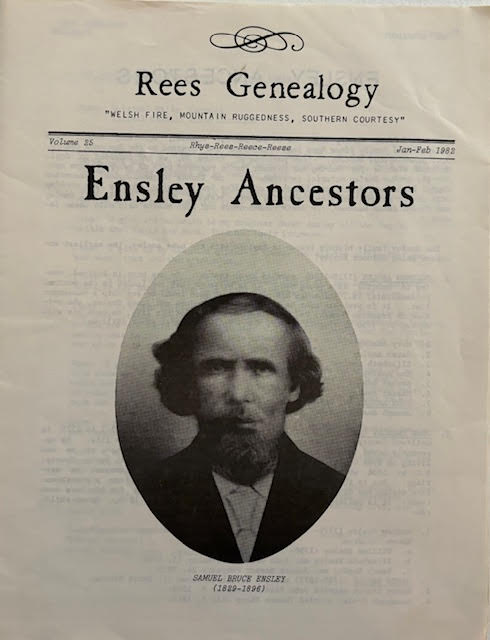
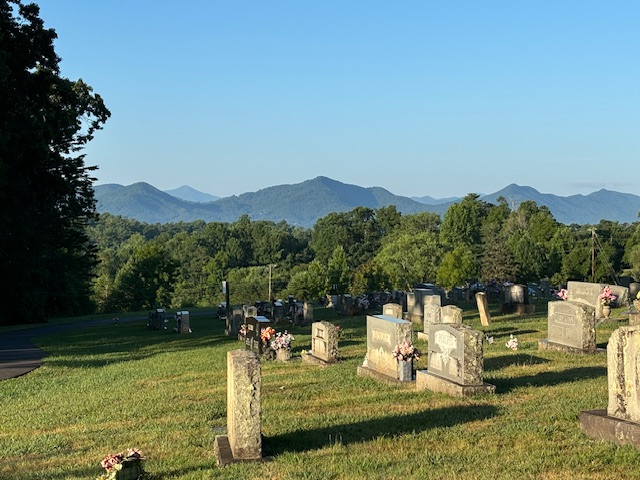
My great great grandfather, Adolphus Erwin Ensley, was born into the Buncombe County Ensley clan in 1831. His brothers, Samuel Bruce and Alfred Webb (my great great uncles), are buried in the Mountain View Freewill Baptist Church cemetery in Leicester, NC. I decided this was the time to find them.
To complete the family tree, my great grandfather, Adolphus Erwin – known as “Dolph” – was born 1872. My grandfather, Ralph Eugene, was born May 26, 1894, and died August 20, 1942. This year marked the 100th birthday of my dad, Alvis Eugene, born August 23, 1924.
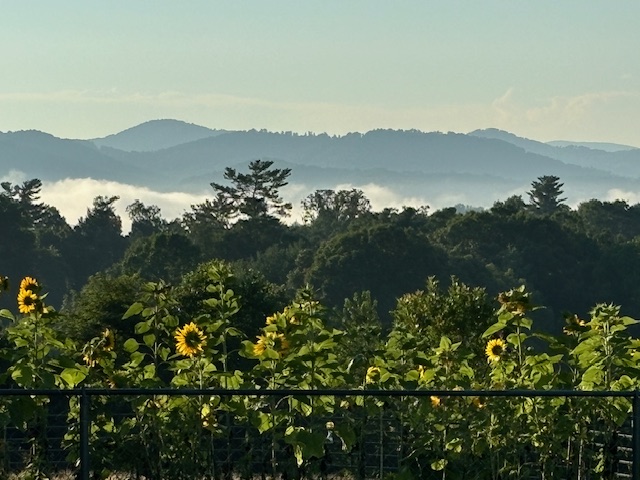
I know I should have stayed for closing worship at the SEJ Conference to remember my baptism, but I was up very early and decided to make my way to Leicester. I followed the GPS directions from the exit on I-40, that exit being about half the distance between Lake Junaluska and Asheville, winding through beautiful valleys and fields as the sun was rising. Luckily the directions had downloaded on my phone because I was without cell service for much of the trip. Along the way, I found myself wondering about the struggles of my family in that valley during the mid- to late 1800s. I worried about cell service; they had to have worried about survival. As I wandered the cemetery with dew soaked feet, the sun rose fully over the Blue Ridge Mountains. A row of sunflowers growing over a metal fence separated the church property from the house beside it. The early morning fog was rising as I spent time searching for headstones.
I decided to let the GPS take me out of Leicester toward home. No idea at all where I was going other than the downloaded map – and even more limited cell service. What a beautiful drive from Leicester through the valleys along the French Broad River, back up the mountains to I-26 in Weaverville! I stopped briefly several times just to look at the river as it flowed so gently that morning, across the rocks and lapping against the river beds. I’m sure everything along that beautiful part of the French Broad River is now gone as the waters last weekend did not flow gently, but rushed so strongly that the entire area has been changed forever.
I didn’t know anything about I-26 until that Friday morning in July, but by the time I came down from the heights of the mountains I had pretty much decided that it would be my route to Western North Carolina from now on. Driving right in the middle of mountains that morning was awe-inspiring. It reminded me of drives along the Blue Ridge Parkway when I was a little girl – but that morning I could go 70-mph, not 25-mph like my Dad drove on the Parkway. I called Steve from the state rest area to tell him how beautiful it was – even sent him a picture of the building! I’ve never taken a picture of a rest area before!! It was still early enough when I reached Erwin, Tennessee that I stopped at Hardee’s for breakfast, then went on to the local Exxon to fill up the car with gas. Erwin – now the place known for hospital roof rescues and a plastic factory where too many lives were lost. And that stretch of I-26 is where pictures are being taken of a highway and bridges washed completely away.
If I hadn’t decided to leave Lake Junaluska early that Friday morning, I would never have experienced this part of the world the way it was that day.
As I sit this morning, holding my tea in a mug from Mud Dabbers Pottery, located in the Balsam area outside Waynesville, NC, I’m reminded of the many ways we are connected across generations, places, and times. Two items at Mud Dabbers caught my attention during a lunch visit while I was at Lake Junaluska – and came home with me: a wacky bird that is sitting on our front porch and a crooked mug stamped with butterflies. The story of the Mud Dabbers family connects with mine in that they began making pottery under the guidance of a family member in Fortson, Georgia, just north of Columbus. My grandfather, Ralph, had two children, Adolphus and Elizabeth, with his first wife. They both settled and raised their families in that area of Georgia and Alabama. The crooked mug reminds me every time I use it that life is not a straight path, but includes curves and bends – like following an unknown path through beautiful mountain valleys and along a scenic river – as well as the unexpected twists that can change life in a second.
Walking home has new meaning this week as I continue to listen and learn to live in this new season of life.
Those who heard me say in the Laity Address at the Virginia UMC Annual Conference that the last year had been a whirlwind had no idea what a squall was taking place in my life at that moment. You had no idea how my feet and legs were dangling as my “house” had been moved from its foundation and landed right on top of me. You had no way of knowing what the show of appreciation before I uttered the first words really meant.
In mid-May, I had a CT scan which brought very unexpected news. I was in to see the surgeon the next week, followed by two weeks of lab tests and waiting on results. The final test result came in on Friday, June 9th. I heard from the surgeon the following Monday and thought that before I got to Roanoke for the start of Annual Conference, the date of surgery would be on the calendar. But, the call didn’t come.
Fifteen minutes into the Laity Heart-to-Heart, the surgeon’s office number came up on my phone. My first chance to listen to the voicemail and return the call was at the lunch break following the opening session. After a little phone tag, surgery was set for June 27th. That call was at 1:30 PM; the Laity Address was on the schedule for 2:00 PM. If you were one of those in the Berglund Coliseum that afternoon, thank you for your support. You had no way of knowing what the show of appreciation before I uttered the first words really meant.
Today marks four weeks following surgery. The pathology reports confirmed that the squall was a very rare, benign tumor that I have to visualize phonetically every time I say it: pheochromocytoma. See why the title is “A Pheo What???”
This is a long apology if you were at Annual Conference and felt that I didn’t give you the full attention you needed. It’s my way of asking for your grace if you’re still waiting on a response or resource (like the list of website links promised in the Laity Session). But this is also a step for me in self-care…in admitting I need to rest and recover.
So the remainder of this summer will be slower. The calendar will not be as full. This could all have been so much more – and like the medical journeys of so many, could have been much longer and more difficult. And so, the next few weeks will include more time for reflection than answering emails, more time sitting on the porch watching God at work in the movement of the leaves and the colors of the rainbow than thinking about church disaffiliations.
There is an organization for those who share this rare journey with pheochromocytoma and paraganglioma. The mascot is a zebra named Phearless. If you google zebras, descriptions of them as spirit animals say things like “zebras symbolize resilience and determination. They’re headstrong creatures that never give up, no matter how difficult the situation may be.”
Forget the whirlwinds. I’m starting the search now for phearless zebra print clothing and accessories for the 2024 General Conference!!
Many years ago now, I offered a message for chapel at the Virginia Conference office about the magnolia tree in the yard of the house next door to the one in which I grew up. I have a number of pictures of my mom holding me on the day I was baptized in April 1961under that magnolia, talking with our neighbor. The tree was fairly small at that time, but so was I! All of the important issues – where acts of faith and witness were needed – first came into my life in the community around the magnolia tree. It was faith taken from the pews of the church and put into action. Faith called upon in times of illness, war, hunger, disaster, personal challenges, and so much more. Faith which made celebrations more joyful and loss easier to bear.
On the eve of another round of disaffiliations from The United Methodist Church, I’ve been thinking about the magnolia tree again. I know what happened to the tree. I wonder what happened in the congregations, including some important in my faith journey, that led to the decision to leave the denomination. What changed? Was it society in general? Was it individual understandings? Or am I just in a different place in my journey as a disciple? Tonight I’m wondering…and thinking about that tree.
No matter what time of the year, you could look out the windows on the side of our house and see signs of life in the magnolia tree – from the birds that roosted there to the evergreen leaves. The smell of those large sweet scented flowers filled the air around our house when they were in bloom and when they were not blooming, you could see those hairy flower bulbs which are borne at the tips of the twigs and know that they would blossom again.
Living in that particular house was a family whose only child had come back to live with them in her middle age, following a mental health crisis. I grew to love and care about JoAnn because my mother and father set the example. Even though she had some rather unusual ways of doing things and preferred to stay in the house alone, she was a part of our neighborhood and loved and cared for. We looked in on her for many years after her parents’ died and until her death.
Families not far from the reach of that magnolia tree lost at least 4 sons to AIDS in the 1980s. I went to school with two of them, one was the first boy to walk me home from school – and the whole reason for the “Walking Martha Home” name of this blog. Of course, we were in the second grade and it was only a short distance! In a small town, 4 men dying of AIDS during that time was a tremendous number.
Next door and in another house just across the road were adult children with intellectual disabilities. When I returned home to worship at the church in which I grew up, a friend with Down Syndrome was often the one to serve one of the communion elements. It was always special to receive the bread or cup from her.
There are many more stories I could tell of how our community around that tree cared for one another. But each one centers on strong faith put into action – sort of like the trunk of the magnolia tree – standing firm, deeply rooted in the teachings of Jesus and an ever-present faith in God. A faith that has been passed on from generation to generation. But without the outstretched branches that tree couldn’t show life – there would be no evergreen leaves or flowers, no birds singing. Faith cannot stand by itself. Like the branches of the magnolia, it is when the faith reaches out in service to others that it blossoms. Remember that the magnolia flower is at the very tip of the twigs on the branches.
The lessons I learned from around the magnolia tree were about an active, living faith. As John Wesley wrote, “Faith hath not its being from works (for it is before them), but its perfection.”
The magnolia tree had to be cut down in 2001 because of disease, but it keeps on giving. I have several bowls made from its branches. I have a rolling pin made from the wood of the tree in our kitchen and a hand mirror on one of our dressers. They will always be reminders to me of the lessons learned from those in my neighborhood about the importance of a living faith. For as James wrote, “If you keep the royal law found in Scripture, “Love your neighbor as yourself,” you are doing right.” (CEB)
So tonight I once again ponder the lessons of the magnolia tree.
Tomorrow will bring the probable ratification of disaffiliation for 64 churches in the Virginia Conference of The United Methodist Church. One is where – if you were at our Annual Conference session last year – as a teenager I so awkwardly tried to sing “Lo, How a Rose E’er Blooming.” When that church name is read tomorrow and the picture shown on the screen, a lump will form in my throat and more than one tear will flow from my eyes.
A part of my faith story will be different from that point forward – and I will wonder what changed in the congregation. Was it society in general? Was it individual understandings? Or am I just in a different place in my journey as a disciple?
Tonight I’m wondering…and thinking about that tree.
I am not one to share a lot of personal information, especially about my own health journey. I’ll talk about Steve’s surgeries and request prayers all day! But not for me. I never even told my mother about most things that were going on with me. Now, here I am making a social media statement!! I mentioned it in the last blog post when I said that I began a journey of greater intentionality about my health last fall and that I got to celebrate the initial benefits with my doctor in December.
In the fall of 2007 – on September 13th to be exact, I was diagnosed with diabetes. Both my parents developed diabetes in their adult years. Other family members did as well. If you are a believer in the role genetics plays in our lives, I was destined to get this diagnosis. However, it also came as a result of being overweight all my teenage and adult years, eating very emotionally, and a multitude of other things that could make this list go on and on. So why do I remember 9/13/2007? I wear it on an ID necklace from the American Diabetes Association which also includes the words, “For my health.”
I was able to stay off medication for five years. For years, I jokingly blamed the 2012 United Methodist General Conference for sending me over the edge to a point of having to start treatment. I know now that there may actually be some truth to that! (See the first bullet below.)
Everything was pretty much under control until the foot surgeries of 2020-2021. Whether from the stress of the surgeries or the lack of activity from being in a walking shoe or boot for a total of six months, my A1C shot up. Despite additions to my medical team and treatment plan, nothing was working to bring it down. It didn’t continue up, but certainly didn’t go down.
Today, I am extremely grateful to Pinnacle Living for providing the opportunity last fall for team members to participate through our healthcare captive in the Twin Health program (https://www.usa.twinhealth.com/). I’ve spent a fortune since I was in my mid-twenties on eating plans and programs: tried all of them. I’ve given a lot of money to fitness centers and classes: given up on all of them. I’ve worked with a number of dietitians and nutritionists: all of whom taught me a lot but I never kept the weight off.
This has been such a different experience. It has been the greatest gift I could have ever received. My first phone call with the Twin Health team was on September 13th, fifteen years to the day of the diagnosis. After my participation was approved, lab work done, and the orientation to the program completed, I officially started in mid-October. Since then, 27.2 pounds are no longer tagging along with me. I’ve been off all diabetes medication for 25 days.
Today is day #122 of the year-long program; I’m a third of the way into this journey. Here are a few things I’ve learned from my virtual twin so far.
Angry church conversations about differences in our understandings of how to be “church” these days cause my blood sugar to spike. Hadn’t had a thing to eat or drink the first time I was able to monitor this, and my blood sugar rose more than 100 points from the time I parked until I got back to my car. I’ve spent a lot of time since then with centering and deep breathing! Before this journey, I would have stopped at the nearest KFC or other fast food place that serves mashed potatoes and taken out my stress with a large serving and LOTS of butter, but I crunched hard on celery all the way home.
When you’re feeding your body and not your emotions, you can be satisfied with the meat, lettuce and tomato from a sandwich in a boxed lunch for multiple meals in a row. That is until all of the leftover food from Annual Conference receptions at the Southeastern Jurisdiction Conference is brought into the room where you are at midnight and there is still much work to do. At least I know now that one petit four does not spike my blood sugar as much as meatballs with barbecue sauce.
Eating too much steamed shrimp over the course of a few weeks (…like Christmas to New Years…) can lead your medical team when they see your blood work to think you are in the midst of an episode of gout. Oh, I remember my Daddy’s toes when his gout would flare up. There goes the genetics again.
Seeing that you only get a few minutes of deep sleep a night helps you understand your brain fog and desire for a nap – along with the need to turn the blue lights of the phone, computer and television off earlier.
Dry wines do not spike your blood sugar. Why didn’t I realize that before now???
When you’ve been careful to eat well for most of 122 days, one Cadbury Crème Egg that you’ve been avoiding even looking at for a week or so does not cause an issue when it’s in celebration of the win – the hard work so far! Thank you, God, for that blessing!!
Why am I sharing all this? I need my Facebook and Word Press friends to hold me accountable for my actions and choices for the next 243 days. I’ve got a long way to go to be healthier in the last third of my life than in the first two-thirds, but I’m on my way.
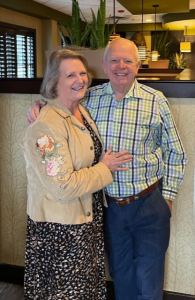
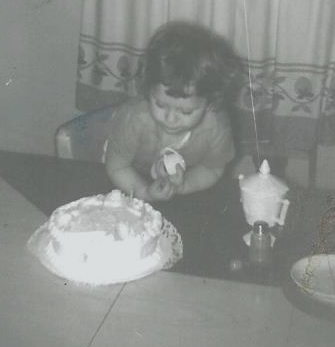
Here’s what celebrating 62 looked like last month. Wonder what 63 will look like? We’ll see what unfolds.
July and August disappeared quickly as we dealt with a hip replacement for Steve, followed by COVID for him, then a second surgery to clear infection from his incision. Thank goodness, it was only infection in the incision, not in the new hip.
The fall was filled with conversations about the future of The United Methodist Church, the work of electing and assigning bishops, and leadership transitions.
My energy was depleted. My heart was aching. The waiting of Advent, the promise of Emmanuel, the opportunity to begin again in a new year had to become much more intentional than ever before. So…
I tried to be much more disciplined in getting up a little earlier to give time in the morning for Advent mindfulness and tea calendars. I was okay until I got to the Indian superfood teas that included black pepper and licorice. I cannot be mindful when my tea tastes like peppered black jelly beans!
After reading about a Jesse Tree, I ordered watercolor ornaments and turned one of our tabletop trees into my own version of a Jesse Tree. This new Advent tradition called me to reading scripture and reflecting on the full story of the birth of Christ in a new way.
I took two weeks off. That had always been the case for the 16 years I worked in the public school system, but that ended 22 years ago. This time it just seemed strange, but was so needed.
In October, I began a journey of greater intentionality about my health. On December 12th, I got to celebrate the initial benefits with my doctor. This journey is to continue for nine more months; I have lots more time to be intentional.
Leading up to the end of 2022, I thought I had settled on my word of intention for the new year. I was ready to write with greater intentionality in 2023, beginning with a post on my word. But this morning, this first day of 2023, that word was far from my thoughts. As I woke and took a long walk with the dogs under the warmth of today’s blue skies, the word that was filling my thoughts was “regret.” Why was this the word emerging today?
Returning from the walk, I came upon these words from John O’Donohue:
We continue in our days to wander between the shadowing and the brightening, while all the time a more subtle brightness sustains us. If we could but realize the sureness around us, we would be much more courageous in our lives. The frames of anxiety that keep us caged would dissolve. We would live the life we love and in that way, day by day, free our future from the weight of regret.
John O’Donohue, Excerpt from BEAUTY
It’s funny how John O’Donohue has made his way into my life over and over again in the last few days: a blessing I sent to a friend yesterday, a text message from another dear friend this morning, this quote. It is another quote from O’Donohue that offered my word for this year. I spent several weeks this summer and fall re-reading To Bless the Space Between Us: A Book of Blessings. I went back several times to read this section over and over as life unfolded.
Within the grip of winter, it is almost impossible to imagine the spring. The gray perished landscape is shorn of color. Only bleakness meets the eye; everything seems severe and edged. Winter is the oldest season; it has some quality of the absolute. Yet beneath the surface of winter, the miracle of spring is already in preparation; the cold is relenting; seeds are wakening up. Colors are beginning to imagine how they will return. Then, imperceptibly, somewhere one bug opens and the symphony of renewal is no longer reversible. From the black heart of winter a miraculous, breathing plenitude of color emerges.
The beauty of nature insists on taking its time. Everything is prepared. Nothing is rushed. The rhythm of emergence is a gradual slow beat always inching its way forward; change remains faithful to itself until the new unfolds in the full confidence of true arrival. Because nothing is abrupt, the beginning of spring nearly always catches us unawares. It is there before we see it; and then we can look nowhere without seeing it.
UNFOLDING…and so it begins on this first day of 2023.
October 31, 2020 – I become the new Virginia Conference Lay Leader in a virtual Annual Conference where I take my Birkenstocks off and talk about standing on Holy Ground.
November 20, 2020 – With COVID still having things shut down, it seems like the perfect time for elective surgery on my right foot. Two weeks after surgery there is a little hiccup, but a round of antibiotics seemed to take care of the issue.
Physical therapy from mid-January to the end of February – Thought I was ready to be released but alas, the doctor came in from looking at x-rays and said, “Do you remember doing anything lately that put extra stress on your foot?” The hardware had pulled completely out of one bone, and there was an impacted fracture in the part of the bone that remained. “We have to fix this as soon as possible because you’ve got 20-30 more years of walking to do.”
March 26, 2021 – Surgery #2 to repair all the stuff that was broken. Beautiful new titanium plate in my foot. Eight weeks of no weight bearing turns into ten. A CT scan at the end of May shows limited healing. Gone is the knee scooter but more time in the walking boot.
June 18 – 19, 2021 – Annual Conference in a walking boot.
Mid-July – Finally get out of the boot only to learn that two staples are interfering with joint movement and need to be removed.
August 6, 2021 – Surgery #3 to remove hardware, while Steve is having an attack of kidney stones in the hospital parking deck. Last thing I hear the doctor say is that she will roll me down to the ER instead of the Recovery Room if Steve is there when I come out of surgery. Two more weeks of the boot.
Flash ahead to this spring when a 5K Run/Walk is announced for the Saturday morning of the Virginia Annual Conference to support the Annual Conference offering. The Conference Lay Leader has to set an example, right? Yet there is no way, walking as carefully as I do these days, that I can even try this walk early on the last morning of the Annual Conference session and be in my seat, ready for Bible Study at 8:30 AM. So I come up with the bright idea that I can tackle the walk following the last Annual Conference planning committee meeting. Who would have guessed that in mid-April the doctor would say “I think you are developing a bone cyst in your big toe joint?” Who could have imagined that the recommendation just last week would be to place carbon fiber inserts in my shoes? Who knew then that it would be 95+ degrees in Hampton on May 31st???
Therefore, since we are surrounded by so great a cloud of witnesses, let us also lay aside every weight and the sin that clings so closely, and let us run with perseverance the race that is set before us, looking to Jesus, the pioneer and perfecter of faith….
Hebrews 12:1-2, New Revised Standard Version Updated Edition (NRSVUE)
This brings me to the lessons learned on Tuesday afternoon.
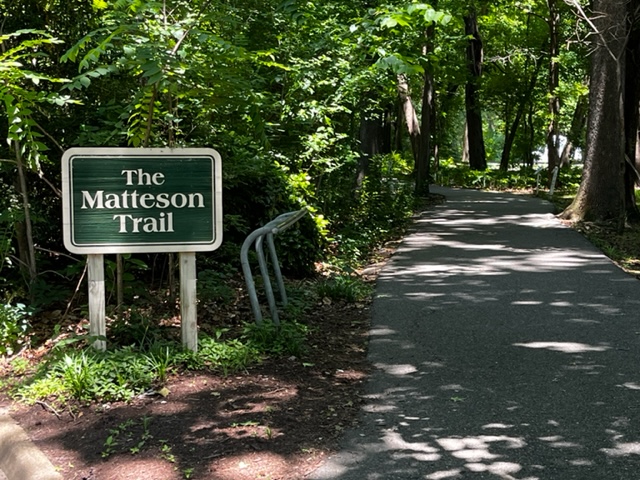
Be courageous. Be bold. Take a risk. Oh, lay leaders, how much do we need this commitment for the ministries of the church today?Coming out of the pandemic, it has been much too easy to slip back into comfortable, safe ways of “being church.” That is not what we are called to be about right now! We need renewal. We need new creativity. We need the fire of Pentecost to fall upon us. I have never walked a 5K before, much less considered it after a seventeen month journey of surgery, recovery and starting to walk again. I had to tell everybody as we were leaving the planning team meeting that I was walking; otherwise, I would have gotten in my car and driven straight home. My Fitbit showed 4,753 steps when I got out of my car at the trail. It read 11,180 when I got back one hour and four minutes later. Slow, but steady – with lots of pictures along the way.
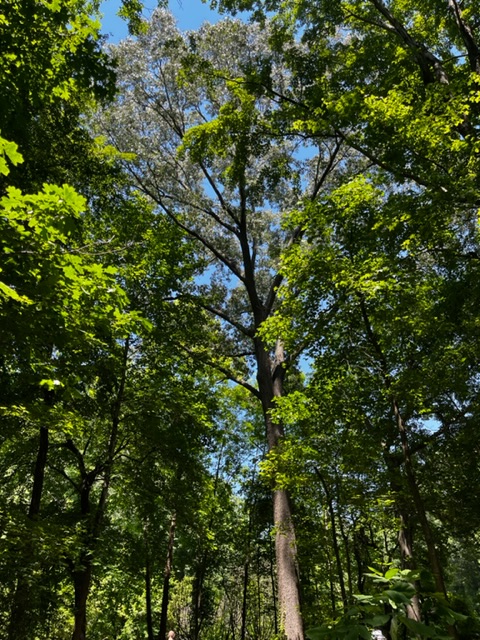
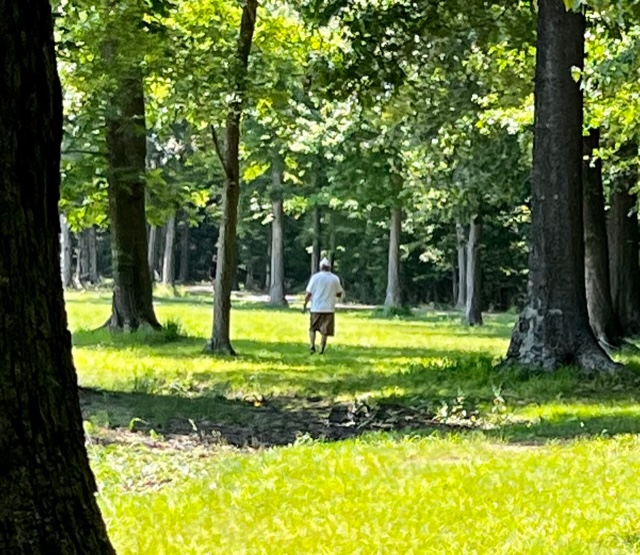
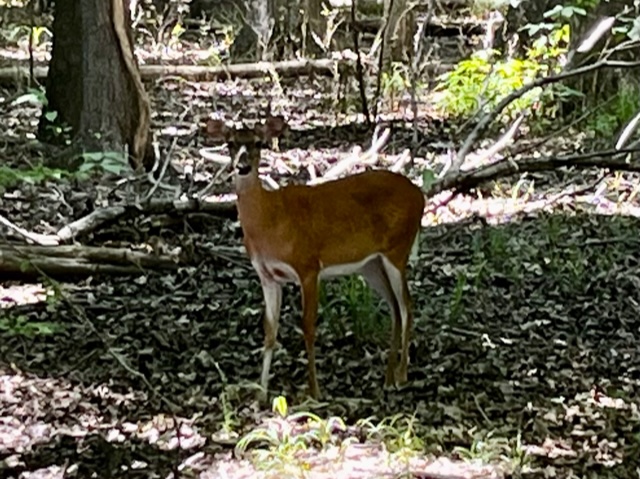
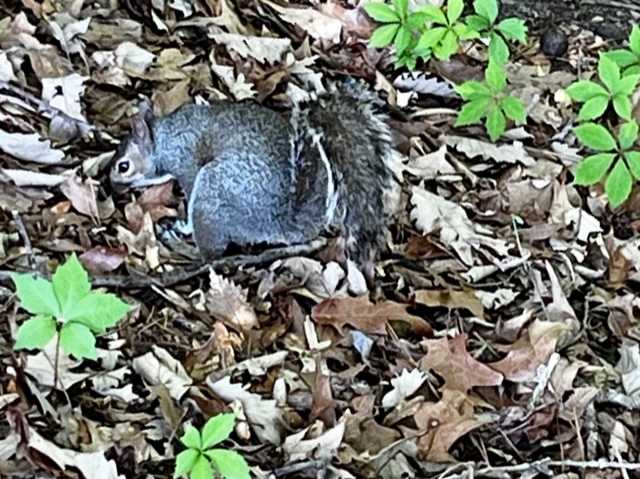
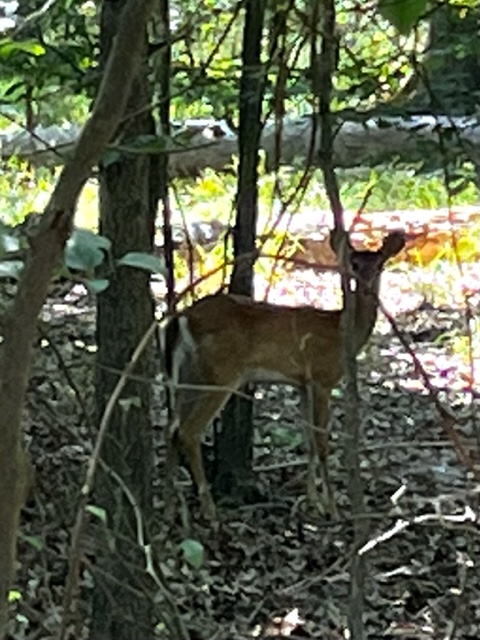
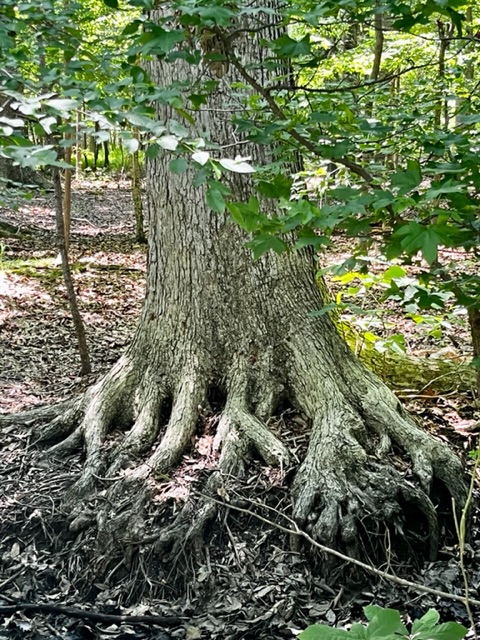
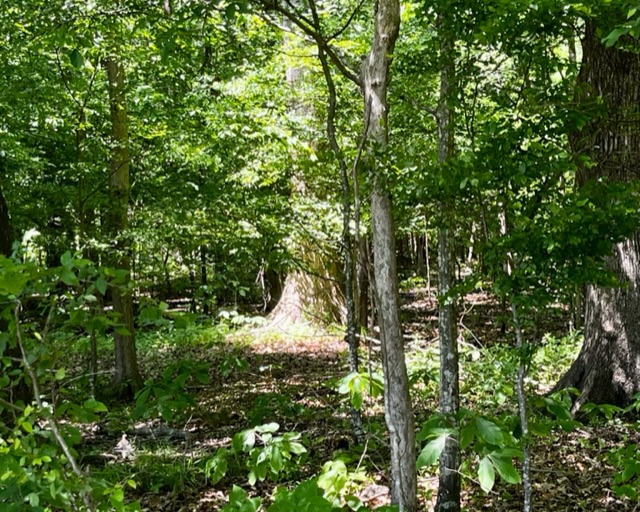
Be observant.Church, we have to recognize the diversity and changing needs in our communities. We have to listen – really listen – to the stories of those we worship with, pass on the streets, spend our working hours with and yes, even those with whom we disagree. We have to see and respect all the people. Signs along the Matteson Trail remind you to look out for golf balls as the trail winds around a local golf course. You also have to look out for the golfers searching for those lost balls…and the deer…and the squirrels…and the tree roots…and the sun peaking through the leaves bringing light into the shadows. You could easily get hurt if you’re not paying attention but more importantly, you might miss the beauty of God’s creation. You might not see the face of Jesus standing right in front of you. You might not hear the Holy Spirit as it moves among the leaves.
Care for yourself. Recognize when you need to rest, when you need to learn something new, and when you need to feed your soul – even if that comes from walking a wooded trail at your very own pace, one step at a time. Find ways for your church leaders – clergy and lay – to rest and renew. Only then can we focus on our mission of making disciples of Jesus Christ for the transformation of the world. There were lots of water breaks, lots of wiping my face on my sleeve while walking, and a moment or two of doubt that I could actually make it all the way without taking a shortcut across the golf course. But know what? I made it all the way!
Celebrate what works and let what doesn’t fade away. Make space for new opportunities. We as church leaders are not the best at having fearless conversations and making challenging decisions as we evaluate ministry programming and attempt to objectively talk about our current contexts. It is so much easier to let things continue as they always have. We can’t do that any more – at church or in our communities. That is not who we are called to be. I wouldn’t have walked this trail if there hadn’t been plans for something new at this upcoming Annual Conference. I probably wouldn’t have even considered it if I didn’t hear the challenge of my doctor saying over and over in my head, “You’ve got 20-30 more years of walking to do.” I pray that I’ve also got 20-30 more years of being the hands and feet of Jesus, 20-30 more years of work to do to build the kin-dom of God.
As I came to the end of the walk, there were weathered, leaning mile markers on each side of the trail. In the direction I was heading, the marker noted the end of three miles. On the opposite side, it marked the beginning of the journey.
We stand in that space at every step of our walk as leaders in today’s church.
It just so happened that as I stood there, taking the last sip of water from the bottle I had been carrying, a couple of jets took off from Langley Air Force Base (just 5 miles away). There had been several flyovers as I walked the trail, but this one was timed perfectly: to honor the risk, to celebrate the finish, to mark the next 20-30 years of walking in the path of Jesus.
“…let (me) run with perseverance the race that is set before (me)…
I was honored today to be part of the 30th Anniversary session of United Methodist Day at the Virginia General Assembly. Legislative advocacy is one way we can and should live what we say we believe as United Methodist, our holiness of heart and life. In the first session of today’s event, several powerful quotes from South African Archbishop Desmond Tutu were shared including:
“I wish I could shut up, but I can’t, and I won’t.
On Saturday, we will have a Special Session of the Virginia Annual Conference to review the details of our denominational settlement as part of the bankruptcy proceedings for the Boy Scouts of America (BSA). Questions have been raised as to why churches that may have never had a BSA troop are being asked to fund part of the settlement. …We are a connectional church. In The Book of Joy: Lasting Happiness in a Changing World, Tutu wrote:
“We are not responsible for what breaks us but we can be responsible for what puts us back together again. Naming the hurt is how we begin to repair our broken parts.”
Since VOICE is my word of intention for 2022, it’s time for me to share my declaration of why I am United Methodist. During his address at the Nelson Mandela Foundation in Johannesburg on November 23, 2004, Tutu said,
“Don’t raise your voice, improve your argument.”
Thank you, April Casperson, Justin Coleman, Andrew Jarrell, Shandon Klein, Bud Reeves, Cory Smith, Molly Vetter, and J.J. Warren, for reminding me of the power of this UMC connection as we have talked about #BeUMC over the last few months! So, here’s why I’m United Methodist. For those of you who take the time to read my story, I invite you to share yours.
Why I’m United Methodist Martha Stokes, Virginia Conference Lay Leader
I grew up United Methodist. Actually, I was baptized Methodist in 1961 and confirmed United Methodist in 1972. A little bit happened in the life of the denomination between those years.
I must confess that it hasn’t been easy to stay United Methodist or even connected to the church. In my 61 years, I’ve experienced my share of unchristian-like behavior when we’ve quarreled over ministries (and ministers); when feelings have been hurt and hearts damaged; when we have forgotten that we, the people, are the church; and when we have failed to live as the people we claim to be – the people Jesus tried so hard to teach us to be. I’ve experienced the hurt and anger of being told as a young woman, eager to serve in the church, that I should not enter the ordained ministry because of my gender. I’ve lived through the highs and very dark lows of serving as a lay delegate to four General Conference sessions. I have questioned how we treat one another, how we forgive each other, and how we continue to grow as disciples of Jesus. I have been totally lost in my faith journey at times. Yet, the conclusion I’ve come to is that I wouldn’t be anything other than a United Methodist Christian.
I want to be United Methodist because we are not all expected to think alike. One of John Wesley’s quotes that I love comes from a letter he wrote in 1749 to a Roman Catholic. Wesley stated: “If we cannot as yet think alike in all things, at least we may love alike.” We have our basic affirmations, our foundational beliefs, which we share with all Christian communities, but with that comes a broad-mindedness to allow for dissenting opinions and differing values with the focus of always striving to live as Jesus modeled for us. We can’t come to understand each other unless we have built relationships that allow us to talk openly, feel safe, and be willing to set our own feelings aside to hear God’s call for ourselves and our church. My greatest desire for our church is that we truly live out more of this understanding in our conferencing, worship, and living.
Another thing that keeps me United Methodist is our understanding of grace. God’s grace has been with me from my first moment. No person can give it to me or take it away. A loving God cares for me no matter how undeserving I may be. Now, my job is to live like I believe it. Living in God’s grace requires that I show the unconditional love of God and model the teachings of Jesus in all that I do and say – 24 hours a day, seven days a week.
I choose to be United Methodist because we believe that we have a responsibility to live out our faith in the world. Our Wesleyan heritage continues to call us to be and to make faithful disciples of Jesus Christ in the realities of today’s society. We are challenged to show compassion to all people: from the poorest of the poor, to the amazingly wealthy; from those whose skin color or lifestyle or abilities are like ours, to those who are as far opposite as possible. It would be so much easier to simply deal with those who are like us, but that is not the calling of the Methodist tradition.
As we pray, study the Scriptures, worship, and share in fellowship with other Christians, we deepen our knowledge of and love for God. As we respond with compassion to human need and work for justice in our communities, we strengthen our capacity to love our neighbors. Our mission together is to use that love for all our neighbors to make disciples of Jesus Christ for the transformation of the world. Because of this, I know I am called to #BeUMC.
With an early January birthday, in my adult years I’ve alternated between setting intentions at the start of the calendar year or waiting until my birthday, the start of my new year. I don’t use the word “resolution,” just like I don’t say I “preach” but offer a message. Surgery on December 28th for my spouse, Steve, made the decision somewhat obvious this year. Our New Year’s celebrations were pretty quiet. What I have struggled with is choosing a word of intention for 2022.
The word that has emerged over the last week is voice.
As of tomorrow morning at 6:53 AM, I will have been in this world for 32,061,600 minutes. I don’t remember ever hearing a story of whether I whimpered, cried loudly or silently entered the world. I know by the time I was a young child that my introverted tendencies were strongly emerging. It didn’t surprise anyone when I got the “unsatisfactory” marks on my high school report cards for not participating in class. My voice – as an advocate for myself and others, as a bridgebuilder, as a person worthy of trust – is something I have had to courageously work to use. My preference is to show you that I care, to express my character and opinions without words, to act upon my intentions – not state them loudly for all the world to hear.
But is that what is needed for this time and this place where we find ourselves at the start of 2022? In some ways, yes – more than ever! I believe, especially as a follower of Jesus Christ, that the world must see me act authentically, living out what I claim to be and profess. Yet, in so many other ways right now, we need non-anxious, steady voices to push for justice and compassion. Voice is needed to speak life to a future that is different from what we are experiencing today. That voice must help us realize that we are not going to return to what was. The voice must call us to accept the uncertainties of not fully knowing what is ahead and move us to be bold, creative and unafraid to take the risks that are necessary to faithfully step forward.
I pray as my new year begins that I use my voice in 2022 to do no harm, to do all the good that I can and to share the message of the unconditional love of God that I know through my relationship with Jesus. Wow! How much more United Methodist can you be?? #BeUMC
How will I use my voice this year? – as the child born over 32-million minutes ago – as sister and aunt – as spouse to Steve – as team member at Pinnacle Living – as Conference Lay Leader?
What happens when you elect an Enneagram Type 9 (Peacemaker), Myers-Briggs ISFJ, and Strength Finders – Harmony, Connectedness, Responsibility, Empathy, Developer type to the role of United Methodist Annual Conference Lay Leader? You get remarks from your Lay Leader like the ones below, delivered through tears.
Many have asked for a copy of the remarks I offered at the end of a very long day last Friday so I’m sharing them here. The very beginning was added on the spot so what you see here is not exactly what you heard – only what I remember adding as I clutched Mrs. Callis’ handkerchief. Here’s the written version of the remarks, minus the very unexpected tears.
During my high school years, Rev. and Mrs. Robert Callis, Jr. were appointed to Fieldale UMC. Mrs. Callis, who had been an early Local Licensed Elder in the Virginia Conference, was instrumental in helping me identify my gifts for use in the life of the church. She always carried an embroidered handkerchief, holding it in her hand each time she preached. Just as many of you who are clergy pass a stole to the person following behind you at a local church or to an entering member of your order, Mrs. Callis passed on her handkerchiefs. Before she left Fieldale, I was blessed to receive one. I carry it with me whenever I know I will be facing something difficult. I wasn’t planning to bring it with me to Annual Conference, but before I left the house this morning I clearly heard that I needed to get the handkerchief out of my dresser drawer. It’s been on the table with my notebook all day and now, I’m going to hold it in my hand tightly as I share my remarks with you. Mrs. Callis was one of the influential people in my faith journey who helped me see God’s call upon my life.
Darlene Amon was another one of those influential people. I would not be standing here today without Darlene’s example, guidance and witness. The announcement of Darlene’s death on May 27th has left a deep sense of emptiness throughout the Virginia Conference.
Darlene was serving the last few months of her term as the Virginia Conference Lay Leader in February of 2000 when I applied for and was offered a position on the Conference Connectional Ministries staff. I knew of Darlene through her leadership with the United Methodist Women and as Conference Lay Leader, but it wasn’t until that interview that I got to finally meet her. That day – in the old Conference Office building on Broad Street, Darlene as Conference Lay Leader and Chair of the Personnel Committee, greeted me with such graciousness. She and the others in the Cabinet Room that day took a risk, offering an unknown lay person the opportunity to lead in a position that had previously only been held by ordained clergy.
Darlene held numerous roles across all levels of The United Methodist Church. I will not note them all but must recognize that she was elected to the General Conference delegation from Virginia every quadrennium since 1992. Darlene served as President of the Southeastern Jurisdiction Association of Annual Conference Lay Leaders and the National Association of Annual Conference Lay Leaders. She was the first woman to serve as the President of the National Association.
The impact of Darlene’s leadership in the church will go on for generations. I am eternally grateful to have learned from her. I would not be who I am today without Darlene’s example. We would not be the church that we are today without her courage and boldness. Join me in a moment of silence to give thanks for the life and witness of Darlene Amon…..Amen.
My sense of time has been thrown off-kilter since stay-at-home orders were put in place 15 months ago. Without consulting the calendar, I could say that it has been a year since I stepped into the role as Conference Lay Leader. Yet it was only eight months ago that I first stood before this body in this role. That day, I asked you to stand with me on holy ground, the sacred space where our words and actions matter more than ever. I slipped my Birkenstock sandals off as I spoke as a symbol that we have been called, just as Moses was before the burning bush, to open ourselves to the uniqueness, the wonders, the holy of this unusual time in which we find ourselves as members of the Body of Christ in this community we call United Methodist.
Three weeks after last year’s Annual Conference, I had foot surgery. Six weeks later when I put my foot back in a shoe for the first time, everything was different. The Birkenstock that had for years been conforming to the shape of my foot didn’t fit. My toes did not fall into the same spaces that had cradled them. The leather straps had stretched to accommodate the shape of my old foot, not my new reality. The footprints I left looked like they belonged to someone else. I spent weeks in physical therapy retraining my toes, ankle and knee to move in different ways. Somewhere in that process, multiple breaks in a repaired bone in my foot required a second surgery. For the last twelve weeks, I’ve been in a beautiful surgical boot. Don’t expect me to slide out of it right now!
Due to the “failure” in the structure of my repaired foot, I have to start again. I’ll be looking for new sandals to conform to a new foot. I’ll be strengthening muscles that haven’t been used for a while and figuring out how to walk on different terrains and along new paths. My footprint has changed again so there will be no stepping in my old patterns or directions.
We are experiencing exactly the same reality as “church.”
The familiar ways of being church don’t fit any more; we are being called to find new opportunities for worship together. We must learn new ways to be and make disciples.
The pews that cradled us so comfortably have given way to being church outside the building. We have always known that’s what we were supposed to be. COVID just showed us that we must be.
The straps that held us in place have stretched and loosened, giving us greater opportunity to reach new places and new people – to step outside what has held us tightly in place.
The footprints that we’ve been following are gone. The walk ahead is not the same as it was in the past. We are being called to redefine and reinvent being “church.”
One of the books I read in the early months of the pandemic was The Time is Now: A Call to Uncommon Courage by Joan Chittister. In the forward, Sister Joan, an American Benedictine Sister, tells us that we have a choice as we stand between two worlds: the world we were told and never doubted would last and the world where we find ourselves living now that defies everything we were taught. She reminds us that we each have a prophet within ourselves, but recognizing that prophet requires us to enter into spiritual discernment where we ask ourselves what we really stand for – and what we have done to prove it.
As a result of that discernment, Sister Joan writes, “we either become prophets – or simply churchgoers.”
“The prophet calls us to the best of what we say we are. The prophet confronts us with the deep-down great goodness of our common call to holiness, to love of neighbor, to commitment to the life of the whole world.” (p. 75, The Time is Now: A Call to Uncommon Courage)
I can’t speak for you, but I want to be this kind of prophet. I believe this type of spiritual prophecy is what we are called to by virtue of our baptisms. Yet the one thing I have heard over and over since November is that we must find new ways to talk about the call to ministry that all of us share.
There have been exciting conversations about how we change our language around “call” to encompass all our varied gifts and talents; ALL of us, not solely those set aside by action of the denomination for licensed and ordained ministry. We are a team – laity and clergy together – both with 100% responsibility for outcomes as we live out our shared vision for the church.
We are excited by the opportunity to focus on this call during the Laity Celebration worship service which will premier on Sunday morning at 11 AM on the VAUMC Facebook page.
As we move forward, you will see how these conversations about our call to ministry are being brought to life through expanded opportunities in Lay Servant and Certified Lay Ministries. You can find a new video celebrating our call to ministry under “The Ministry of the Laity” section of the Conference website. (https://vaumc.org/lay-servant-ministries/)
God continues to call us to stand as witnesses to the dual pandemic of COVID and racial injustice as well as to the power of our faith and congregations – even when we don’t have answers about the future of The United Methodist Church.
It is hard for me to describe what a joy it has been to share my kitchen with Deborah Straughter, Hungsu Lim and Dan Kim as we created the first two episodes of Diversity Kitchen. My hope for Diversity Kitchen is that we can model a way of bringing people of different cultures together over the love of food and love of Jesus that furthers conversation and relationship-building.
The efforts of the Call to Action Work Group for Racial Justice and Reconciliation have created resources and events to guide discussion around systemic racism, division within our communities and social unrest. On this eve of Juneteenth, we recognize more than ever before that we cannot sit as observers to the events of the last 15 months. We will not go back to normal nor can we be silent. We are called as prophets of our time to create safe spaces for hard conversations – just as Jesus did – so that our understanding of and love for one another can grow.
Our acts of witness and servant leadership often mean we need to let go of old ways and old thinking that may allow us to perceive that some people are better than others and deserve more, while accepting that other people, ideas or dreams are disposable. None of us is disposable in the Body of Christ. We are so much stronger together, even when we disagree.
I have taken these last eight months to listen. Laity and clergy: I hear you today and will continue to actively listen to all voices.
In the reality of leading in this space of not having answers about the future of our denomination:
I ask you to pray for the delegation as we participate in a called session of the Southeastern Jurisdiction Conference on July 21st. This session is being called for the purpose of voting on a resolution from the Tennessee and Memphis Conferences to unite the two conferences to form the Tennessee-Western Kentucky Conference. Delegates will also receive reports on the pandemic response in the jurisdiction, the work of antiracism across the jurisdiction, and the work of the jurisdiction moving forward.
There is ongoing discussion as to how best to move forward with preparation of the delegation in anticipation of the postponed General and Jurisdictional Conferences.
Expect updates at next year’s Annual Conference on the work of the General Conference which is now scheduled for August 29 – September 6, 2022, and the Jurisdictional Conference which be held the following November.
Twenty-five or so years ago, Darlene Amon wrote an article that has been widely distributed about laity and clergy working as partners in ministry. I could not close with any better words than these that she wrote from her heart, as a prophet of her time. She wrote:
“This new style of partnership calls for ministry and leadership to be shared by the pastor and local church laity. It calls for teams of lay and clergy to trust each other, to always seek win/win solutions, to keep agreements, and to assume full responsibility. We can’t become what we need to be by remaining what we are. When we risk enough to move from where we may have been for years by opening ourselves to the transforming work of God in Jesus Christ, there’s no telling what will happen in our lives, our churches, and our annual conferences.”
Here these words again:
“We can’t become what we need to be by remaining what we are. When we risk enough to move from where we may have been for years by opening ourselves to the transforming work of God in Jesus Christ, there’s no telling what will happen in our lives, our churches, and our annual conferences.”

 Stilll Walking Martha Home